Put Sleep First
Why we’ve built health in the wrong order.

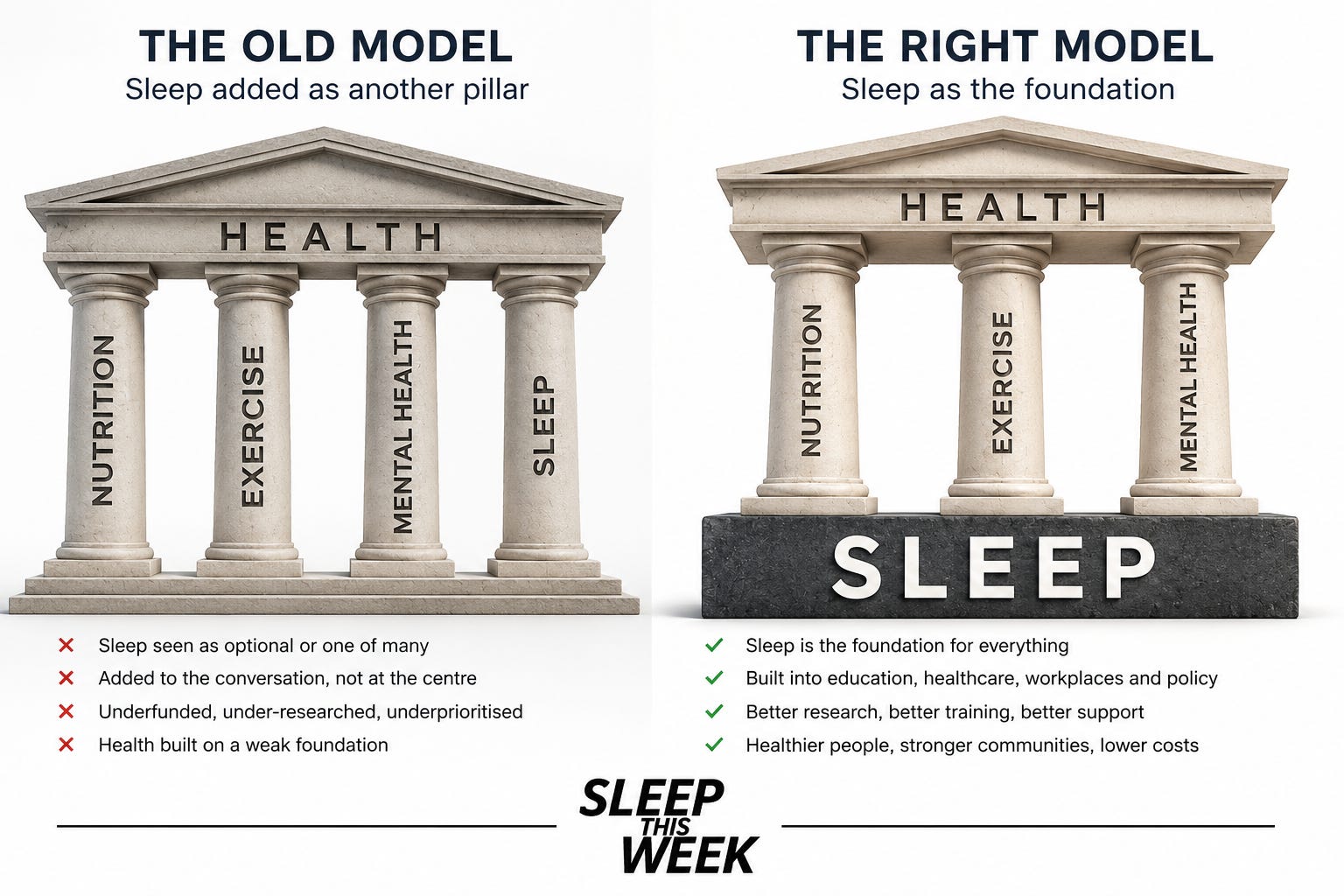
You’ve probably seen the picture.
A Greek temple with the word Health across the top. Four pillars holding everything up. Nutrition. Exercise. Mental Health. Sleep.
It’s a useful model. It reminds us that good health rarely comes down to one thing. We need to eat well, move regularly, look after our mental wellbeing and sleep well.
Every time I see it, though, I find myself thinking the same thing.
I don’t think sleep belongs as one of the pillars.
I think it belongs underneath them.
But before we dive in, lets find out what has been happening in Sleep This Week,,,,,,
😴 Sleep This Week
🫁 One Night Sleep Studies Come Under Pressure
New research from Flinders University has questioned whether a single night sleep study is enough to accurately diagnose obstructive sleep apnoea. The researchers found that sleep apnoea severity can vary considerably from night to night, meaning some people could be missed or their condition underestimated if only one night is assessed.
Why it matters: This adds to the growing argument for multi night assessment and a more personalised approach to diagnosing sleep apnoea.
🛏️ Diamond Mattress Launches Auto Pilot 2.0
Diamond Mattress has unveiled its redesigned Auto Pilot 2.0 Smart Sleep System, combining biometric tracking with automatic comfort adjustment and a modular design aimed at making smart beds easier for retailers to explain and support.
Why it matters: Smart beds continue to evolve, but the challenge remains the same. Can manufacturers turn clever technology into meaningful improvements in sleep rather than simply adding more features?
❤️ Sleepy Days, Restless Nights and Blood Pressure Risk
Researchers at Penn State have found that excessive daytime sleepiness was associated with higher odds of hypertension, with the risk increasing further in people who also took more than 30 minutes to fall asleep.
Why it matters: Sleepiness shouldn’t simply be accepted as part of modern life. It can be an important indicator that something more significant is affecting both sleep and long term health.
🤖 The Mattress Industry Starts Taking AI Seriously
A thoughtful article in BedTimes Magazine explores how artificial intelligence is beginning to influence the mattress industry, from product design and manufacturing to retail and customer support.
Why it matters: AI won’t transform the sleep industry simply because companies add it to their marketing. The winners will be those who use it to improve judgement, customer support and decision making rather than just creating more data.
👋 What I’ve Been Up To
Last week I was in London with Being Human for their Don’t Forget Your Sunscreen event, spending the morning with a fantastic group of in house lawyers. We explored human factors, how organisations can genuinely help people become more resilient and, of course, why sleep has to be part of that conversation if we want people to perform at their best.
It was a brilliant morning with some great conversations. Here’s what Josh thought of the session.
I also spent the week helping people prepare for England’s early morning World Cup match against Mexico, sharing practical advice on the radio and across my Instagram channel about how to enjoy the football without completely disrupting your sleep.
Now back to the main read, why should we put sleep first?
For nearly two centuries we’ve invested in understanding nutrition. Exercise science has been shaping healthcare, rehabilitation and elite sport for generations. Mental health has rightly become one of the defining public health conversations of our time, with dedicated services, research funding and increasingly open public debate.
Sleep has travelled a very different road.
Modern sleep medicine is remarkably young. The first dedicated sleep disorders clinic at Stanford University opened in 1970. REM sleep itself wasn’t identified until the 1950s. CPAP, one of the most important treatments for obstructive sleep apnoea, only became established during the 1980s. Even the NICE guidance recognising Cognitive Behavioural Therapy for insomnia (CBT-I) as the first line treatment for persistent insomnia is relatively recent. Compared with nutrition, exercise and mental health, sleep is still a young clinical discipline.
That matters because while we have gradually added sleep to the conversation about health, we haven’t really changed the way we think about it. We’ve simply added another pillar to the temple.
I think we’ve put sleep in the wrong place. Rather than asking it to stand alongside nutrition, exercise and mental health, we should recognise it as the foundation that allows all three to flourish. Sleep isn’t another health behaviour competing for our attention. It’s the thing that makes so many of the others easier.
The evidence increasingly points us in that direction. One of the most interesting examples comes from mental health. For many years poor sleep was viewed largely as a symptom of depression or anxiety. We now know the relationship runs both ways. Improving sleep can reduce symptoms of depression in many people, while successfully treating depression does not always restore healthy sleep. That doesn’t mean sleep replaces psychological therapy or medication, but it does remind us that sleep is doing far more than reflecting our mental health. In many people it is influencing it as well.
Once you begin looking at sleep through that lens, it changes the questions you ask.
What would education look like if we genuinely put sleep first?
Teenagers experience a well understood shift in their body clock during adolescence. Yet many are still expected to begin learning at a time when their biology is encouraging them to remain asleep. We have good evidence that later school start times can improve attendance, wellbeing and academic performance, yet they remain relatively uncommon. Instead of asking why teenagers are tired, we should ask whether we’ve designed an education system that works against their biology.
What would workplaces look like?
Imagine beginning a career as a shift worker and receiving personalised sleep education before your first shift. Not generic advice lifted from the internet, but support that considers your chronotype, your family life, your commute and the pattern of shifts you’ll actually be working. We know shift work increases the risk of accidents, cardiovascular disease, diabetes and poor mental health. Supporting sleep shouldn’t be viewed as an optional wellbeing initiative. It should sit alongside every other health and safety measure.
What if becoming a parent meant receiving practical support for your sleep as routinely as you receive advice on feeding, recovery and your baby’s development? No one expects new parents to sleep perfectly, but understanding how sleep changes, how to protect it where possible and when disrupted sleep needs additional support could make one of life’s biggest transitions just a little more manageable.
What about young athletes? We celebrate commitment, early mornings and extra training sessions, but how often do we stop to ask whether those schedules are helping young people learn, recover and develop as well as they could? Sleep is when much of that adaptation happens. If we put sleep first, we might think differently about when we ask young athletes to train, not because we’re lowering standards, but because we’re raising them.
Healthcare would almost certainly look different too.
Someone visiting their GP because they are exhausted would still need blood tests where appropriate. They might still need support for their mental health. But sleep would no longer be an afterthought. The first conversation would include questions about how they are sleeping, whether a sleep disorder could explain their symptoms and what sort of support is actually needed.
Not everybody who sleeps badly needs a sleep clinic.
Some people need reassurance that what they’re experiencing is normal.
Some need better education about sleep.
Some would benefit from coaching.
Others need investigating for conditions such as obstructive sleep apnoea, restless legs syndrome, narcolepsy or idiopathic hypersomnia.
Putting sleep first isn’t about sending everyone to a specialist. It’s about getting the right help to the right person at the right time.
That principle extends far beyond sleep medicine.
Imagine every physiotherapist routinely considering sleep because healing, pain and rehabilitation are influenced by it. Sleep position might become part of recovering from a shoulder injury. Fragmented sleep caused by pain might become something to address rather than simply accept.
Imagine every psychologist and mental health practitioner feeling confident recognising when sleep is maintaining distress, not just accompanying it.
Imagine addiction services routinely addressing sleep because persistent sleep disruption is associated with a greater risk of relapse, rather than waiting until recovery is well underway before talking about it.
Imagine every healthcare professional leaving university with a solid understanding of healthy sleep, the most common sleep disorders and when someone should be referred for specialist assessment. One of the more frustrating conversations within sleep is the suggestion that healthcare professionals receive too little education in sleep medicine. Too often that point is made by organisations promoting private clinical services. The underlying issue is real, but perhaps we’ve been asking the wrong question. Rather than criticising doctors, nurses and allied health professionals for what they weren’t taught, we should ask why sleep still occupies such a small place within many healthcare curricula. If sleep really is foundational to health, then putting sleep first should begin in our universities, not our marketing.
The same question applies outside healthcare.
What would happen if every company developing a sleep product, sleep service or sleep technology began with one simple question?
Which poor sleeper will this genuinely help?
Some products change lives. Some services offer outstanding support. Others wrap themselves in the language of sleep science while offering very little evidence that they improve sleep in the real world. Putting sleep first doesn’t mean slowing innovation or discouraging new ideas. It means making sure innovation serves the sleeper before it serves the marketing.
For years we’ve talked about raising awareness of sleep. We’ve encouraged people to prioritise it. We’ve reminded them how important it is.
Yet the systems around them often make good sleep harder rather than easier.
The education system.
The workplace.
Healthcare.
Elite sport.
Parenthood.
Commercial innovation.
Professional education.
They all influence how well we sleep, yet sleep is rarely one of the first considerations when those systems are designed.
One reason for this is that sleep is still catching up. Nutrition has had generations to establish itself within healthcare, education and public policy. Exercise science has followed a similar path, while mental health has quite rightly become one of the defining health priorities of recent decades. Sleep has not enjoyed the same journey. It has received less research funding, fewer specialist services, less space within professional education and far less attention from policymakers. When you realise how young sleep medicine is as a discipline, that shouldn’t really surprise us. What should surprise us is that we’ve expected it to have the same influence as subjects that have been developing for generations.
If sleep really is the foundation of health, then putting it first isn’t about asking people to spend longer in bed or chase perfect sleep. It’s about designing our schools, our workplaces, our healthcare system and even our commercial innovations around a much simpler question: does this make it easier for people to sleep well?
We have spent generations learning how to nourish the body, strengthen it and care for the mind. Sleep is still catching up. Giving it the same priority won’t happen overnight, but it has to start somewhere.
I can’t think of a better place to start than putting sleep first.
James Wilson (AKA The Sleep Geek) is a Sleep Educator, Coach & Product Expert. He is genetically pre disposed to poor sleepers, and is severely sight impaired, and although sleeps a lot better now, is honest about his own struggles with sleep.
He is the founder of Sleepunity, a social enterprise committed to Better Sleep For All. He appears regularly on ITV’s This Morning and BBC Breakfast and has worked with the likes of Zurich, Budweiser, Under Armour and West Ham United helping their people sleep better.
He coaches individuals and has worked with shift workers, women living with the menopause international footballers, Olympic athletes and the odd famous person or two.
He offers training and certification for retailers, and a certification scheme for sleep products.
He and his team also help sbrands develop sleep products and services, and he has worked extensively in traditional sleep products like mattresses and pillows, in sleep tech, sleep tracking, supplements and on product development using insight from the 100,000’s of poor sleepers they have worked with.
To get the latest news, and a long sleep read to your inbox every week why not subscribe?
To get the latest news, and a long sleep read to your inbox every week why not subscribe?