Sleep Hygiene Isn’t the Problem. Sleep Hygiene Rules Are.
What years of working with poor sleepers has taught me about sleep hygiene, sleep advice, and why rules often make sleep worse

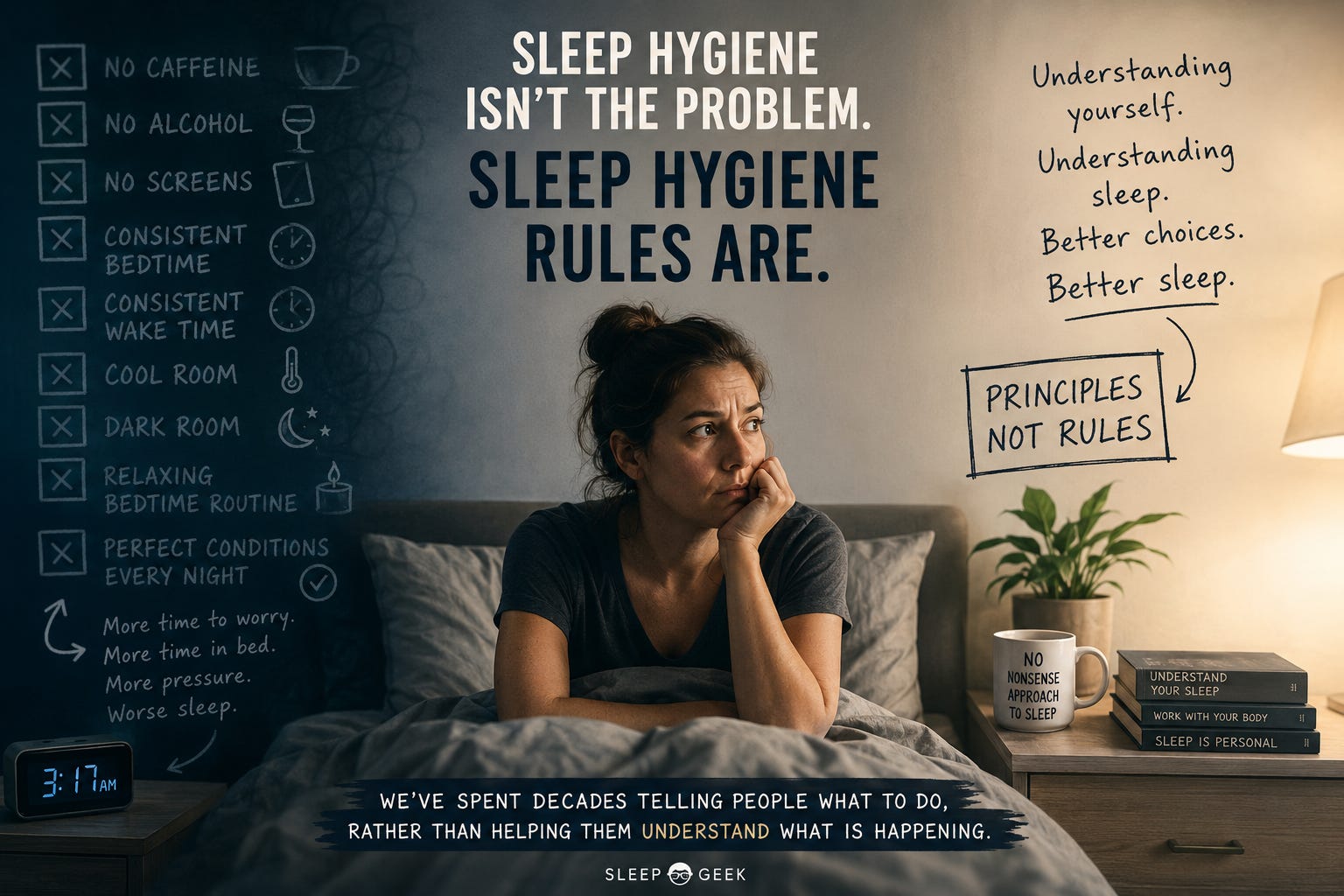
What do you think of the Sleep Hygiene Rules and how would you change them? Let me know in the comments.
A recent TEDx talk by psychologist and sleep specialist Dr Jade Wu prompted me to revisit one of the most common concepts in sleep.
Sleep hygiene.
Her argument was simple. Sleep hygiene rules make sleep worse, most of the time, and we would probably be better off ditching them.
As somebody who has spent years working with poor sleepers, I found myself agreeing with almost every word.
Not because sleep hygiene itself is a bad idea. Far from it. The idea that our environment, habits and routines can influence sleep is both obvious and sensible. But somewhere over the last fifty years, something strange happened. A collection of observations and suggestions slowly evolved into a list of rules. Those rules became the foundation of public sleep education, and today they are repeated endlessly by health organisations, sleep brands, journalists, wellbeing programmes and social media influencers.
Before we go any further, can we also acknowledge what a peculiar phrase “sleep hygiene” actually is? If your goal is public education, it is a remarkably poor piece of communication. Nobody naturally knows what it means. It sounds clinical, slightly judgemental and oddly disconnected from everyday life. If somebody told you they were working on their eating hygiene or exercise hygiene, you would probably wonder what on earth they were talking about.
In many ways, the phrase perfectly captures the sleep world’s approach to public education for much of the past half century. Complex language, expert terminology and a tendency to make sleep feel more mysterious than it really is. We have spent decades telling people what to do, rather than helping them understand what is happening.
But before I get too carried away with this story (Sleep Hygiene Rules make my teeth itch) here is the latest news in Sleep This Week…..
😴 Sleep This Week
Welcome to this week’s Sleep This Week. We’ve got new thinking on insomnia treatment, fresh research on chronotypes, more developments in women’s sleep health and another attempt by the sleep-tech world to turn sleep into a number. As always, I’ve done the reading so you don’t have to.
📖 Major Review Maps the Future of Insomnia Treatment
A major new review published in Nature Reviews Disease Primers looks at where insomnia treatment could be heading over the next decade. The paper explores everything from behavioural approaches and digital therapeutics to medication, neurostimulation and personalised care. What I like about this review is that it recognises something many poor sleepers already know: there probably isn’t going to be a single magic solution. Sleep is complicated, people are complicated, and effective treatment is likely to become more personalised rather than less.
🧠 New Research Links Night Owl Behaviour to Loneliness
Night owls often get told they’re lazy, disorganised or simply need to go to bed earlier. This new research suggests the reality may be more complicated. Researchers found that people with later sleep schedules reported higher levels of loneliness and anxiety, raising interesting questions about whether society is forcing some people to live against their biological clock. As always, correlation doesn’t equal causation, but it’s another reminder that sleep timing matters.
🎧 Sleep Audio Technology Continues to Evolve
If you’ve ever fallen asleep listening to a podcast, audiobook or the Shipping Forecast, you’ll know sound can play an important role in sleep. The latest generation of sleep audio products is trying to move beyond simple background noise and create more personalised experiences based on what is happening while you sleep. Whether that translates into better sleep remains to be seen, but it’s certainly more interesting than another lavender spray.
♀️ Women’s Health Continues to Shape Sleep Innovation
For years, women’s sleep was treated as an afterthought in sleep research. Thankfully that’s changing. More companies are now looking at how hormones, menopause and menstrual cycles influence sleep, which is good news because half the population has been trying to apply advice that was often developed without them in mind. Expect this area to continue growing as both researchers and product developers start taking women’s sleep more seriously.
⌚ Sleep Cycle Launches New Sleep Score
Sleep Cycle has launched a new Sleep Score which it says gives a better picture of sleep quality. Sleep scores are becoming increasingly sophisticated, but the fundamental challenge remains the same: if you can’t accurately measure the sleep in the first place, the score itself doesn’t mean much. All they have to do now is reliably pick up the signal and measure my sleep accurately, and they’ll be sorted.
🏡 What I’ve Been Up To
🎙️ Talking Sleep, Expertise and Men’s Health on the Torque Podcast
I sat down with Dom Fiore from the Torque Podcast to discuss my journey in sleep, why I respect excellence rather than titles when it comes to sleep expertise, and the important role sleep plays in men’s health. We also discussed some of the biggest myths in the sleep world and why helping people sleep better is often more about common sense than complicated biohacking.
💬 Are We Too Quick to Blame the Practitioner?
This week’s most popular LinkedIn post tackled a question I’ve been thinking about for a while. When poor sleep coaching or education happens, are we too quick to blame the practitioner while ignoring the organisation that trained them? My view is that the profession needs to start at the beginning and demand better standards from training providers. Some organisations are delivering training in ways that are, at best, questionable and, at worst, unethical. If we want better sleep support for the public, the foundations need fixing first.
👋 Until Next Week
The big theme this week is that sleep is becoming more personal. Whether it’s understanding chronotypes, recognising the impact of hormones, tailoring insomnia treatment or building better sleep technology, the future of sleep looks less like generic advice and more like helping people find what works for them
The brands seem to be finally getting it in theory, but will they deliver it in practice?
The Rules That Made My Sleep Worse
When my own sleep was poor, I did what almost every poor sleeper does. I followed the rules.
I cut out caffeine. I stopped drinking alcohol. I avoided screens before bed. I went to bed at the same time every night. I got up at the same time every morning. I made the bedroom cooler. I made it darker. I tried to create the perfect conditions for sleep.
And do you know what happened?
My sleep got worse.
Not because those things are inherently harmful, but because they created exactly the conditions my worried brain didn’t need. I suddenly had more time to think about sleep. More darkness to contend with. More silence. More opportunity to monitor myself. More opportunity to notice every awakening. More opportunity to wonder why I wasn’t asleep yet. More opportunity to ask myself whether I was following the rules properly.
The harder I tried to follow the rules, the more important sleep became. The more important sleep became, the harder it became to sleep.
Over the years I have heard versions of this story from hundreds of thousands of poor sleepers. The people most likely to follow sleep hygiene rules are rarely the people who sleep well. They are the people struggling the most. They are the people desperately searching for an answer. They are the people lying awake at three in the morning wondering what they are doing wrong.
And when the rules don’t work, they often assume the problem is them. Not the advice. Not the rule. Them.
How Sleep Hygiene Became Sleep Advice
The irony is that sleep hygiene started life as a perfectly reasonable concept. Developed by psychologist Peter Hauri in the 1970s, the original intention was to identify behaviours and environmental factors that appeared to support healthy sleep. It was never designed to be a treatment for chronic insomnia. It was never intended to become a rigid set of commandments. It was certainly never intended to become the primary form of sleep education delivered to millions of people.
But over time suggestions became recommendations, recommendations became rules, and rules became content.
Today, sleep hygiene has become almost synonymous with sleep advice itself. Search online for help with sleep and you will be presented with endless versions of the same list. Avoid caffeine. Avoid screens. Keep your bedroom cool. Go to bed at the same time every night. Wake up at the same time every morning.
The repetition creates the impression of certainty. We hear these messages so often that they begin to feel unquestionably true.
Yet the evidence for sleep hygiene as a treatment for poor sleep has always been surprisingly weak. If a simple list of sleep hygiene rules genuinely solved sleep problems, sleep clinics would barely exist. The reality is that understanding why somebody is struggling to sleep is usually far more important than handing them a generic list of instructions.
That is because poor sleep is rarely caused by a single behaviour. It sits in the middle of our lives. It is influenced by stress, health, relationships, work, caring responsibilities, finances, mental health, physical health, timing, biology and circumstance. Trying to solve all of that with a list of generic rules was always unlikely to succeed.
The Contradiction At The Heart Of The Advice
One of the most frustrating aspects of sleep hygiene rules is that they often contradict the very treatments that sleep specialists use to help people with insomnia.
Take NHS advice as an example. On one page you may find recommendations encouraging people to maintain a consistent bedtime. On another page discussing insomnia treatment, you may find advice telling people not to go to bed unless they feel sleepy.
These ideas point people in completely different directions. One says, “Go to bed because the clock says it is bedtime.”
The other says, “Go to bed because your body says it is time to sleep.”
For many people experiencing insomnia, the second approach is considerably more useful. Yet the first continues to appear throughout sleep hygiene advice.
The result is confusion. People end up trying to force sleep rather than allowing sleep to happen. They become more focused on following rules than understanding what their body is actually telling them.
Once again, we see the same problem. The emphasis is placed on what people should do rather than helping them understand what is happening.
The Real Problem With Sleep Hygiene Rules
To be clear, there is nothing wrong with having a comfortable bedroom. There is nothing wrong with reducing noise, thinking about caffeine or creating a relaxing wind down routine.
Sleep hygiene is not the problem. The rules are. Because rules assume everybody is the same.
A shift worker is not the same as a retiree. Somebody going through menopause is not the same as a university student. A parent of a newborn is not the same as an athlete. Someone with ADHD is not the same as someone without it.
Yet we continue to offer them the same advice.
This is also why sleep hygiene has become such a useful tool for organisations wanting to project authority. Sleep brands use it. Non sleep experts use it. Marketing agencies use it. Workplace wellbeing programmes use it. It is easy content to create because the rules are already there waiting to be recycled.
Unfortunately, recycling advice is not the same thing as helping people.
What often happens is that poor sleepers become trapped in an endless cycle of trying harder, following more rules and feeling increasingly frustrated when nothing changes. Every new article feels like another opportunity to fix themselves. Every new rule becomes another thing to remember. Every failed night becomes evidence that they are somehow getting sleep wrong.
Why We Created The No Nonsense Approach To Sleep
This is one of the reasons we developed the No Nonsense Approach to Sleep.
After speaking to hundreds of thousands of poor sleepers through coaching, education, retail, workplace wellbeing programmes and media work, one thing became abundantly clear. Most people do not need more rules. What they need is understanding.
They need to understand who they are, how they sleep, what might be driving their difficulties and what principles actually matter in their circumstances.
The goal is not to tell everybody the same thing.
The goal is to help individuals understand what they should do and why.
That is a very different approach to education.
Instead of handing somebody a checklist, you help them make sense of their own experience. Instead of treating sleep as a rule based system, you treat it as a human one. You acknowledge that sleep happens in the context of a person’s life, not in a laboratory, and that advice only becomes useful when it fits the person receiving it.
For us, that has always felt like a more respectful and ultimately more effective way to help people sleep better.
Because the real job of sleep education is not to tell people what to do.It is to help them understand what is happening.
One Small Change
I know the world has bigger problems than sleep hygiene. But I genuinely believe one relatively small change would help millions of people.
The NHS should remove sleep hygiene rules from its websites.
Not sleep hygiene.
Not practical advice.
Not education.
The rules.
Replace them with principles. Replace them with explanations. Replace them with context. Replace them with advice that acknowledges people are different and that sleep is shaped by far more than a simple checklist.
Because after years of working with poor sleepers, I have become convinced of one thing.
We have spent decades telling people what to do, rather than helping them understand what is happening.
Sleep hygiene rules are perhaps the clearest example of that mistake. They do not teach people how to sleep. Far too often, they teach people how to worry about sleep.
And that might be one of the least hygienic things we can do.
James Wilson (AKA The Sleep Geek) is a Sleep Educator, Coach & Product Expert. He is genetically pre disposed to poor sleepers, and is severely sight impaired, and although sleeps a lot better now, is honest about his own struggles with sleep.
He is the founder of Sleepunity, a social enterprise committed to Better Sleep For All. He appears regularly on ITV’s This Morning and BBC Breakfast and has worked with the likes of Zurich, Budweiser, Under Armour and West Ham United helping their people sleep better.
He coaches individuals and has worked with shift workers, women living with the menopause international footballers, Olympic athletes and the odd famous person or two.
He offers training and certification for retailers, and a certification scheme for sleep products.
He and his team also help sbrands develop sleep products and services, and he has worked extensively in traditional sleep products like mattresses and pillows, in sleep tech, sleep tracking, supplements and on product development using insight from the 100,000’s of poor sleepers he has worked with